The Case for Clear AI Rules: Why Smart Regulation Fuels Innovation Instead of Stifling It
And Why Executive Orders and the Great American AI Act Are Not The Solution
There is a persistent myth floating around the AI policy world right now that regulation kills innovation. The argument is that if we impose rules on artificial intelligence companies, we will smother the extraordinary pace of progress that has made the United States the undisputed leader in AI development, and will cause us to fall behind our adversaries like China. Much like the nuclear arms race with Russia, many argue that a failure to win this “race” could be a threat to our freedoms and very existence in the future.
It sounds compelling on the surface. But when you look at what is actually happening in the AI industry right now, the opposite is true. The absence of clear, predictable federal rules is creating more uncertainty, more risk, and more cost for the very companies and investors who are supposed to benefit from a hands-off approach.
The Shadow Policy Problem
Before we get into the specifics of what the administration has been doing, it is worth stepping back and remembering how lawmaking is supposed to work in this country. Article I of the U.S. Constitution vests legislative power in Congress, not the President. The Founders set it up like this because they wanted laws to emerge from debate, compromise, and the accountability that comes with elected representatives casting public votes. The entire structure of separated powers exists precisely so that no single branch of government can unilaterally set the rules for an entire industry.
An executive order is not a law. It is a directive from the President to the federal executive branch, instructing agencies and their employees on how to carry out their duties and priorities. Executive orders can shape how existing laws are enforced, how federal agencies allocate resources, and what standards apply to companies that want to contract with the federal government. But they cannot create new legal obligations for private citizens or businesses the way a statute passed by Congress can. They can be reversed by the next president with the stroke of a pen. They do not go through committee hearings, public comment periods, or floor votes. They are, by design, a tool of executive management, not legislation.
That distinction is vital to understand because the Trump administration has repeatedly used executive orders as an attempted substitute for the legislative process on AI. The administration has issued orders on AI safety, AI procurement, AI bias in government models, preemption of state AI laws, and now cybersecurity review of frontier models. Each one arrives with a press event and bold language that creates the impression of sweeping policy change. And the political effect is real: it looks decisive, it looks like the President is in control, and it generates the kind of headlines that suggest the AI question has been settled. But it has not been settled, because executive orders are not law. These orders are nothing more than a signal of where the President wants the law to go, but they are not law and are not a binding obligation.
The deeper problem is that this approach is not just optics. It is a deliberate effort to control the shape of AI regulation without going through Congress, which is the branch of government that actually has the constitutional authority to set national policy on this issue. It also attempts to preempt states’ rights to regulate their own economies and citizens’ activities, something only Congress can do, and even Congress is limited in what it can preempt. By issuing executive orders that establish voluntary frameworks, create litigation task forces to challenge state laws, and condition federal funding on compliance with administration preferences, the White House is effectively trying to build a regulatory architecture through the back door. And in doing so, it is sidelining the very institution that has the power and the obligation to create durable, enforceable rules.
On June 2, 2026, President Trump signed an executive order titled “Promoting Advanced Artificial Intelligence Innovation and Security.” The order establishes a voluntary framework for government review of advanced AI models, asking companies to provide the federal government with early access to frontier models for up to 30 days before release. Within 60 days, agencies including the Treasury Department, NSA, CISA, and NIST must develop a classified benchmarking process to assess the cybersecurity capabilities of AI models and determine when a model should be treated as a “covered frontier model.”
On paper, this sounds like a reasonable middle ground. In practice, it represents something far more concerning: the emergence of a shadow regulatory system that shapes the AI industry through ad hoc executive actions, company-specific interventions, and informal backroom negotiations rather than through clear, published rules that everyone can follow.
Consider what has happened with Anthropic in recent months. The company has been engaged in an extended dispute with the administration over export controls, military use restrictions, and the government’s designation of the company as a “supply chain risk” after it refused to waive contractual restrictions on mass surveillance and autonomous weapons. On June 12, the Commerce Department issued an export control directive forcing Anthropic to disable its most advanced models for all customers worldwide, with no advance notice.
Whether you agree with the government’s position or Anthropic’s, the process itself should alarm anyone who cares about a predictable business environment. There were no published standards that triggered the action. There was no formal rule-making process. The decision emerged from a series of tense phone calls between company executives and senior administration officials, and it affected hundreds of millions of users overnight.
This is what governance by improvisation looks like. And it is the worst possible environment for the companies, investors, and innovators who are trying to build the future.
Why Uncertainty Costs More Than Compliance
When people argue against AI regulation, they typically frame compliance costs as a drag on innovation. And compliance does cost money. But uncertainty costs far more.
When a company cannot predict where regulatory boundaries will land, it faces a cascading set of problems. Capital becomes more expensive, because investors demand higher returns to compensate for regulatory risk they cannot model. Product development slows, because engineering teams have to build for multiple possible regulatory scenarios rather than one clear set of requirements. Strategic planning becomes nearly impossible when a single phone call from a government official can upend your entire business model overnight.
The current patchwork of state AI laws makes this even worse. California, New York, Illinois, Colorado, Connecticut, Texas, and a growing list of other states have all enacted their own AI requirements, each with different scopes, different definitions, and different enforcement mechanisms. California’s Transparency in Frontier AI Act took effect January 1, 2026. New York’s RAISE Act was amended in March 2026. Illinois passed SB 315, which would require mandatory third-party audits of frontier AI models. Colorado repealed and replaced its original AI Act with a narrower statute focused on automated decision-making technology.
Meanwhile, the Trump administration has established an AI Litigation Task Force specifically to challenge state AI laws it considers inconsistent with federal policy, while simultaneously failing to propose a clear federal alternative. The result is a regulatory environment where companies must comply with a maze of overlapping state requirements while also navigating a federal executive branch that operates through voluntary frameworks, executive orders, and one-off interventions.
Compare this to what clear federal regulation would provide: a single, predictable set of rules that companies can build around. Yes, compliance costs money. But compliance is a known cost. You can budget for it, plan around it, and factor it into your product roadmap. You cannot budget for a surprise export control directive that shuts down your most advanced products overnight.
And the domestic patchwork is only part of the problem. Other countries are moving far more quickly on national and even multinational AI regulation. The European Union has been the most proactive, with the AI Act establishing comprehensive requirements that apply across all 27 member states. The United Kingdom has its Online Safety Act. Other nations are developing their own frameworks. U.S. companies that want to operate globally, which is virtually all of them at this scale, have to comply with those foreign regulatory regimes whether or not the United States has its own framework in place. That compliance work is happening regardless.
So when Congress takes a hands-off approach to AI regulation, it is not actually reducing the regulatory burden on American companies. It is increasing it. Companies are left navigating a growing number of state laws, a stream of unpredictable executive actions, and an expanding set of foreign regulatory requirements, all without a coherent federal framework to anchor their compliance programs. There is a deep irony here, because the hands-off posture is largely the result of lobbying by the AI companies themselves, many of whom have spent years arguing that they should not be regulated at all. But by succeeding in that lobbying effort, they have created an environment that is more expensive, more uncertain, and more disruptive to innovation than a well-designed federal framework would ever be. If Congress genuinely wanted to protect American competitiveness, it would smooth the path by creating a national regulatory framework that gives companies one clear set of rules to follow, instead of forcing them to spend enormous time and money navigating dozens of state regimes alongside the requirements of every foreign jurisdiction where they do business.
That kind of regulatory clarity does not just help AI companies manage their operations; it stabilizes the broader economic environment by giving investors, public markets, and global currency markets the confidence that comes from knowing the rules of the game, which has ripple effects across the entire U.S. economy.
Congress Is Starting to Move, But Slowly and Questionably
Congress has begun to engage with AI regulation, but the most prominent effort so far raises more questions than it answers about whose interests are actually being served.
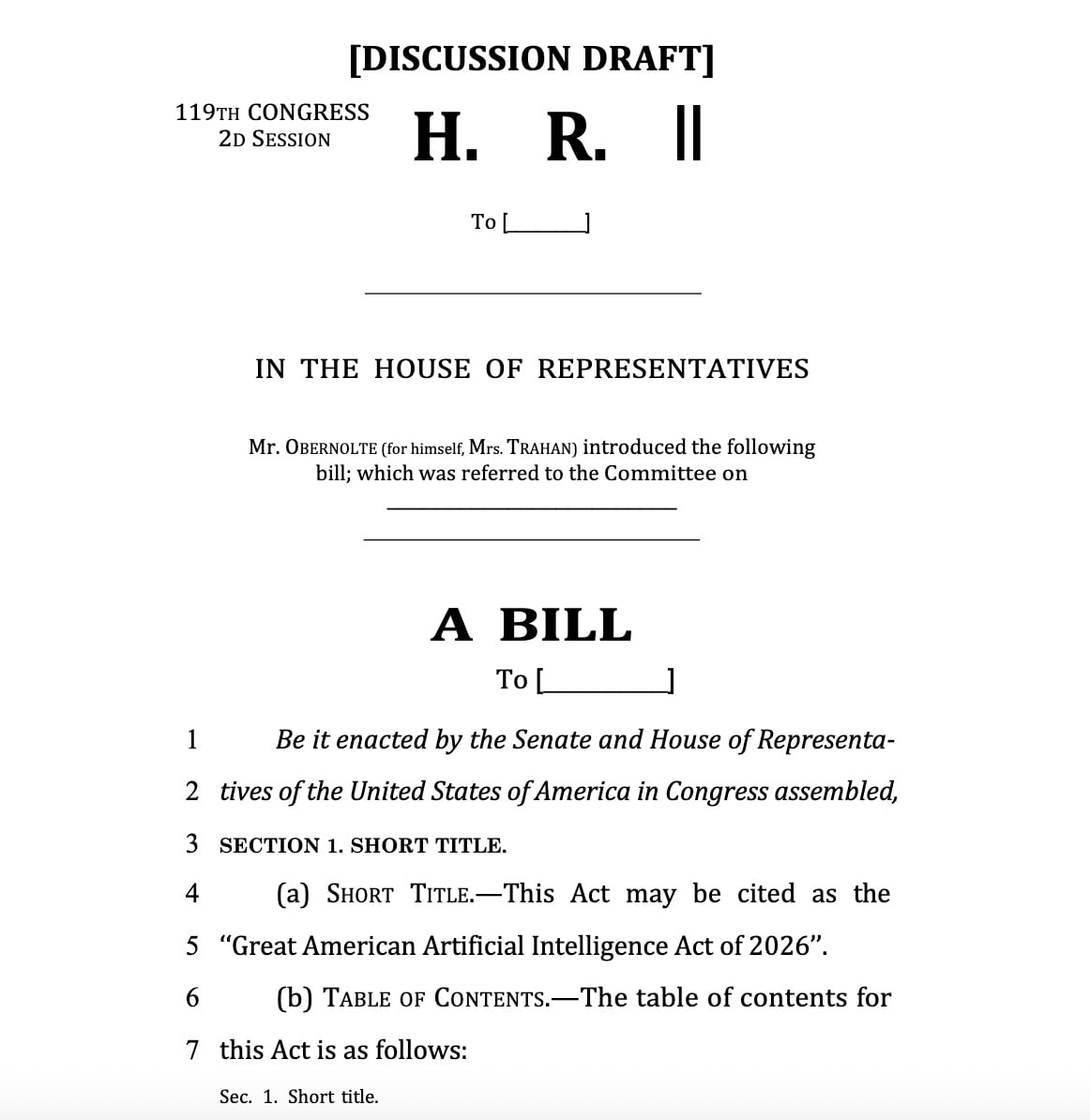
In early June 2026, Representatives Jay Obernolte (R-CA) and Lori Trahan (D-MA) released a bipartisan discussion draft called the Great American AI Act. The bill is 269 pages long. It would formally codify the Center for AI Standards and Innovation within the Commerce Department, authorize $100 million per year in funding, and establish requirements around frontier AI transparency, critical safety incident reporting, whistleblower protections, and independent verification organizations. It also includes a three-year preemption clause that would prohibit states from enforcing or enacting any law specifically regulating AI model development.
On the surface, this looks like serious, comprehensive legislation. But when you examine what it actually requires, a different picture emerges.
The bill’s central mechanism is a system of self-authored frameworks and self-selected auditors. Large frontier developers would be required to write and publicly post their own “frontier AI framework” setting out their risk thresholds, safety procedures, and deployment decisions. They would then hire and pay their own independent verification organizations to audit whether they are following their own frameworks. The government entity that receives the resulting reports, CAISI, has no authority under the bill to block, delay, or order changes to an AI model based on what it finds. The transparency reports that developers must file can be redacted to protect trade secrets, cybersecurity, public safety, or national security, categories broad enough to cover virtually anything that would matter for public accountability. And the fines, capped at $1 million per day, are for procedural violations like failing to file paperwork, not for deploying a dangerous system. For companies generating billions in annual revenue, that is not a deterrent. It is basically a rounding error.
The structural conflict of interest at the center of this framework should sound familiar. The developer writes the rules. The developer selects and pays the auditor. The auditor checks whether the developer is following the developer’s own rules. This is the same model that allowed credit rating agencies, selected and paid by the banks whose securities they were rating, to rubber-stamp the mortgage-backed instruments that triggered the 2008 financial crisis. We have seen this play out in industry after industry: companies will not meaningfully regulate themselves when profits are at stake. I have written previously about why industry self-regulation consistently fails, and nothing about this bill changes the fundamental dynamic.
Compare this with the European Union’s AI Act, which took full effect in August 2026. The EU Act is a binding regulation, not a voluntary framework. It classifies AI systems into four risk tiers, from unacceptable to minimal, and assigns specific, mandatory obligations to each tier. Certain AI practices are outright prohibited, including social scoring systems, AI that exploits vulnerable populations, emotion recognition in workplaces and schools, and untargeted facial image scraping. For high-risk AI systems used in employment, credit scoring, healthcare, and law enforcement, the EU Act requires conformity assessments completed before deployment, detailed technical documentation, functioning risk management systems, and human oversight mechanisms allowing human review and override of AI decisions. Fines reach 35 million euros or 7% of total worldwide annual turnover, whichever is higher. For context, 7% of global revenue would cost Microsoft roughly $16 billion. The EU Act also integrates with GDPR, so AI systems that process personal data face simultaneous enforcement under both frameworks. And it has extraterritorial reach, meaning it applies to any organization whose AI systems affect people in the EU, regardless of where the company is headquartered.
The Great American AI Act does none of this. It prohibits nothing. It mandates no pre-deployment safety testing by an independent government body. It gives no government entity the authority to pull a dangerous system from the market. It establishes no substantive safety standards. And it would preempt the very state laws that have been filling the gap left by federal inaction.
It is also worth looking at who is behind the bill and who supports it. Obernolte, who chairs the House Republican Policy Committee, has been one of Congress’s most vocal proponents of blocking state AI regulation. In October 2025, he was tapped by HumanX, a tech conference company, and Humanrace Capital, a venture capital firm, to launch the “AI Coalition,” a nonprofit specifically designed to give AI startups access to Washington policymakers and influence over regulation. Membership runs $1,750 to $3,500 per month. Trahan, for her part, had previously been a strong advocate for state AI regulatory authority, but reversed course to co-author a bill whose preemption clause was immediately denounced by the ACLU, Public Citizen, Public Knowledge, the AFL-CIO, Americans for Responsible Innovation, and more than 200 state legislators from both parties. Rep. Ted Lieu, who co-chaired the original House AI Task Force with Obernolte, said the draft “cannot serve as the basis for productive dialogue.” Polling showed that majorities of both Obernolte’s and Trahan’s own constituents oppose weakening state AI protections.
The bill’s industry supporters tell you everything you need to know. The Business Software Alliance and the Information Technology Industry Council praised it. These are the lobbying arms of the very companies the bill is supposed to regulate. When the entities being regulated celebrate the regulation, that is a signal that the proposed regulation has no teeth.
The label “bipartisan” gives the bill a veneer of legitimacy, but what the Great American AI Act actually accomplishes is the thing AI company CEOs have wanted most: the appearance of federal regulation that preempts meaningful state oversight while allowing the industry to write its own rules, hire its own auditors, and face penalties too small to incentivize or deter harmful behavior. It addresses none of the substantive risks that matter most, including environmental impact, privacy rights, data protection, citizen surveillance, deepfakes, child protection, algorithmic discrimination, and the concentration of power in a handful of companies with no meaningful external checks.
Regulation as a Competitive Advantage
Here is the part of this argument that often gets lost in the political noise: well-designed regulation is not just compatible with innovation. It IS a competitive advantage.
Think about it from an investor’s perspective. If you are putting hundreds of millions of dollars into an AI company, you want to know the rules of the game. You want to know what safety standards your portfolio company needs to meet, what disclosures are required, and what happens if something goes wrong. Clear regulations answer those questions. A shadow policy of ad hoc executive actions and backroom deals does not.
The European Union has taken a different approach with the EU AI Act, establishing comprehensive rules that, whatever their flaws, at least give companies a clear framework to build within. The United Kingdom has its Online Safety Act. Both are imperfect, but both provide something the U.S. currently lacks: predictability.
The irony of the current situation is that by trying to keep government out of the AI industry’s way, the administration has actually made government intervention more arbitrary, more unpredictable, and more disruptive than a well-designed regulatory framework would ever be. When there are no clear rules, every decision becomes a judgment call made by individual officials with their own priorities and political calculations. That is not deregulation. That is regulation without accountability and at risk of corruption.
What Smart AI Regulation Should Look Like
To be clear, the goal should not be regulation for its own sake. The goal should be a regulatory framework that does what regulation is supposed to do: protect people and the environment from foreseeable harms, provide clear rules that companies can build around, and create accountability when things go wrong.
First, meaningful AI regulation must establish substantive safety standards with real enforcement. AI systems that can identify software vulnerabilities, generate deepfakes, make consequential decisions about employment, healthcare, and lending, or enable mass surveillance need binding guardrails. Not voluntary frameworks. Not self-authored risk thresholds. Binding, enforceable rules with penalties large enough to change corporate behavior. The EU AI Act provides a model: certain dangerous practices are outright prohibited, high-risk systems must pass conformity assessments before deployment, and fines reach 7% of worldwide annual turnover. That is regulation with teeth. What we have been offered in the Great American AI Act has none.
Second, regulation must provide clear, predictable guidelines so companies know how to innovate within defined boundaries. This is where the current approach fails most dramatically. A voluntary framework that can be ignored, changed or revoked with a single executive order, combined with a patchwork of state laws that the federal government is simultaneously trying to invalidate and prevent, does not give anyone the certainty they need to make long-term investment decisions. A well-designed federal framework, one that establishes actual standards and consequences for violations, rather than process requirements with no enforcement mechanisms, would resolve that uncertainty and reduce costs for everyone. And any such framework must include codified conflict of interest rules for the people administering it. Regulators and oversight officials cannot be industry insiders. They cannot be permitted to hold or trade stock in AI companies, or in the companies that provide infrastructure, energy, or components to the AI industry, while serving in a regulatory capacity. This should mirror the stock trading restrictions that we need for members of Congress, and for the same reason: if the people making or enforcing the rules stand to profit from the industry’s unchecked growth, they have every incentive to look the other way when clear risks emerge. The same principle applies to backroom negotiations between regulators and the companies they oversee. Regulatory decisions must be made through transparent, documented processes with published standards, not through private phone calls and informal deals that no one outside the room can scrutinize or challenge.
Third, regulation must create a level playing field with genuinely independent oversight. When regulation happens through self-authored frameworks, self-selected auditors, one-off deals, and company-specific executive interventions, it advantages incumbents who have the resources and political connections to navigate the chaos and disadvantages smaller companies and startups that cannot afford armies of lobbyists and compliance consultants. Clear, universal rules with truly independent government oversight eliminate that dynamic and give startups without massive backing or resources a chance to compete.
Fourth, and this is a point that gets far too little attention, AI regulation must address the staggering environmental cost of this technology. A June 2026 United Nations University report found that global data centers used 448 trillion watt-hours of electricity in 2025, more than all but ten countries in the world. That electricity use produced roughly 208 million metric tons of carbon dioxide, about the same as Argentina. Data centers consumed approximately 1.2 trillion gallons of water globally, and those numbers are projected to double by 2030. A single hyperscale data center can consume 200 million gallons of water per year just for cooling, and nearly all of that water evaporates, making it impossible to recycle. In the United States, AI data centers are projected to consume between 200 and 300 billion gallons of water annually by 2030.
These are not abstract statistics. In Memphis, residents raised alarms over an xAI data center drawing millions of gallons daily from aging public water infrastructure. In South Carolina, a Google facility faced sustained community opposition over its proposed groundwater use. In Ireland, data centers consumed 21% of the country’s total metered electricity in 2023, exceeding all urban households, and the national grid operator paused new approvals around Dublin until 2028. Communities near data centers are watching their drinking water drawn down, their groundwater depleted, their air quality degraded by the fossil fuel plants built to power these facilities, and their energy grids strained to the breaking point. AI companies are externalizing enormous environmental costs onto the communities that can least afford to bear them.
The Great American AI Act says nothing about any of this. No environmental impact requirements. No water use restrictions. No mandate that AI companies pay the true cost of the energy they consume. No obligation to develop cooling technologies that do not deplete or pollute local water supplies. Nothing.
The EU, once again, is ahead. The European Energy Efficiency Directive requires data centers to report power usage effectiveness and water usage effectiveness metrics. The EU AI Act includes energy consumption reporting requirements for general-purpose AI models and mandates that the Commission develop energy efficiency standards. The EU’s Cloud and AI Development Act, adopted in June 2026, conditions data center development support on compliance with energy efficiency, water efficiency, and circularity requirements. Researchers at MIT and ETH Zurich have demonstrated that data center waste heat can be repurposed for carbon capture and water purification, a technology that could make data centers carbon-negative and water-positive. European researchers are pursuing these innovations because the regulatory environment demands it. AI companies have shown they can innovate on environmental sustainability when they are required to. They will not do it voluntarily, because the cheapest approach is always to draw down local water supplies and plug into the nearest power grid regardless of the source.
Any serious federal AI regulatory framework in the United States must require AI companies to pay the full cost of the energy they consume, develop and deploy cooling technologies that do not deplete or contaminate community water supplies, disclose their water consumption, energy use, and carbon emissions in standardized, verifiable formats, and meet binding efficiency standards. If we are going to allow an industry to consume electricity at the scale of a mid-sized nation, we should at minimum require that industry to account for its environmental footprint and invest in the technology to minimize or eliminate it. Americans and American communities deserve the same protections that European communities are getting.
The Industry’s Own Case for Regulation
The companies building the most advanced AI systems in the world are not asking for a regulatory-free environment. Many of them are actively calling for clear federal rules. Anthropic supported Illinois SB 315 and has publicly stated that “enforceable accountability matters more than ever.” OpenAI reversed its earlier opposition to state frontier model legislation. These companies understand something that the political rhetoric often obscures: the absence of regulation is not the same as the absence of government interference. It just means the interference comes without warning, without consistency, and without recourse.
The Ball is In Congress’ Court
Congress has a constitutional obligation to act on AI regulation, and so far it has failed to meet that obligation. The Great American AI Act is not the answer. It is a 269-page exercise in giving the appearance of regulation while handing the industry exactly what it wanted: the power to write its own rules, hire its own auditors, and operate free from meaningful government oversight. Congress can do better, and the American public deserves better.
What is needed is a federal framework with actual substantive standards, genuinely independent oversight, meaningful penalties, environmental accountability, and protections for privacy, civil rights, and democratic institutions. The EU has demonstrated that this is possible. Multiple U.S. states have demonstrated that the political will exists. What has been missing is federal leadership willing to prioritize the public interest over the preferences of the companies spending millions to lobby them and control and shape the outcome.
The alternative to real regulation is not a regulation-free “paradise.” The alternative is what we have now: a shadow policy of executive orders, backroom deals, and company-specific enforcement actions that creates the risk of corruption, more uncertainty, more risk, and more cost than any well-designed regulatory framework ever would. And the environmental, social, and economic consequences of continued inaction will only compound with each passing month.
Smart regulation does not kill innovation. Uncertainty kills innovation. And unchecked power, left to regulate itself, has never once in the history of American industry produced the outcome that the public needed.
Sources
Jessica Eaves Mathews: “The Theater of Responsible AI Leadership” (Substack)
https://jessicaeavesmathews.substack.com/p/the-theater-of-responsibleai-leadership
Executive Order: “Promoting Advanced Artificial Intelligence Innovation and Security” (June 2, 2026)
https://www.whitehouse.gov/presidential-actions/2026/06/promoting-advanced-artificial-intelligence-innovation-and-security/
White House Fact Sheet on AI in the National Security Enterprise (June 2026)
https://www.whitehouse.gov/fact-sheets/2026/06/fact-sheet-president-donald-j-trump-signs-historic-directive-on-ai-in-the-national-security-enterprise/
Great American AI Act Discussion Draft Text
https://obernolte.house.gov/sites/evo-subsites/obernolte.house.gov/files/evo-media-document/the-great-american-ai-act-discussion-draft-website-compressed-compressed.pdf
Great American AI Act Section-by-Section Summary
https://trahan.house.gov/uploadedfiles/gaaia_discussion_draft_section-by-section.pdf
Future of Privacy Forum: “Frontier AI Goes Federal: How the Great American AI Act Compares to State Laws” (June 9, 2026)
https://fpf.org/blog/frontier-ai-goes-federal-how-the-great-american-ai-act-compares-to-state-laws/
IAPP: “A View from DC: A Bipartisan Blockbuster Bill on AI” (June 2026)
https://iapp.org/news/a/a-view-from-dc-a-bipartisan-blockbuster-bill-on-ai
FedScoop: “Bipartisan ‘Great American AI Act’ Draft Proposes New Federal AI Governance Framework” (June 4, 2026)
https://fedscoop.com/bipartisan-great-american-ai-act-draft-proposes-new-federal-ai-governance-framework/
Tech Oversight Project: Constituent Polling on Obernolte-Trahan AI Bill (June 2026)
https://techoversight.org/2026/06/04/obernolte-trahan-ai-poll/
ACLU: Reaction to Great American AI Act Draft (June 2026)
https://www.aclu.org/press-releases/aclu-reacts-to-draft-bipartisan-ai-bill-that-would-preempt-state-laws
Americans for Responsible Innovation: Response to Obernolte-Trahan Proposal (June 2026)
https://ari.us/reps-trahan-obernolte-propose-bill-to-preempt-state-ai-laws/
Coalition Letter to Rep. Trahan Opposing State Law Preemption (May 21, 2026)
https://techoversight.org/wp-content/uploads/2026/05/Final-No-AI-Preemption-Letter.pdf
Axios Boston: “Trahan Faces Progressive Pushback Over Federal AI Regulation Plan” (June 17, 2026)
https://www.axios.com/local/boston/2026/06/17/trahan-ai-regulation-plan-progressive-pushback
Benton Institute: “AI Startups Find a D.C. Advocate in Rep. Obernolte” (October 2025)
https://www.benton.org/headlines/ai-startups-find-dc-advocate-rep-obernolte
NPR: “Trump’s New AI Safety Order Seeks Voluntary Review of New Models” (June 2, 2026)
https://www.npr.org/2026/06/02/nx-s1-5844347/ai-safety-trump-executive-order
Axios: “Trump Dodges AI Rules for Now with Latest Executive Order” (June 2, 2026)
https://www.axios.com/2026/06/02/trump-signs-new-ai-executive-order
CNBC: “Trump Signs AI Executive Order Asking Companies to Give Government Early Access to Models” (June 2, 2026)
https://www.cnbc.com/2026/06/02/trump-executive-order-ai.html
Scientific American: “Trump’s New AI Executive Order Drastically Shifts the Administration’s Stance on the Tech” (June 2, 2026)
https://www.scientificamerican.com/article/trumps-new-ai-executive-order-drastically-shifts-the-administrations-stance-on-the-tech/
A&O Shearman: “White House Issues Executive Order on AI and Cybersecurity” (June 2026)
https://www.aoshearman.com/en/insights/trump-administration-issues-executive-order-on-ai-and-cybersecurity
McDermott Will & Emery: “New Executive Order Shifts US AI Policy Toward National Security” (June 9, 2026)
https://www.mcdermottlaw.com/insights/new-executive-order-shifts-us-ai-policy-toward-national-security/
Nextgov: “Anthropic Suspends Top AI Models After U.S. Export Control Order” (June 2026)
https://www.nextgov.com/artificial-intelligence/2026/06/anthropic-suspends-top-ai-models-after-us-export-control-order/414173/
IAPP: “The Global Implications of the White House’s Export Controls on Anthropic” (June 2026)
https://iapp.org/news/a/the-global-implications-of-the-white-houses-export-controls-on-anthropic
Corruption, Crime & Compliance: “When the Government Pulls the Plug: Anthropic, Export Controls, and the Future of AI Governance” (June 14, 2026)
https://blog.volkovlaw.com/2026/06/when-the-government-pulls-the-plug-anthropic-export-controls-and-the-future-of-ai-governance/
King & Spalding: “New State AI Laws Are Effective on January 1, 2026, But a New Executive Order Signals Disruption” (January 2026)
https://www.kslaw.com/news-and-insights/new-state-ai-laws-are-effective-on-january-1-2026-but-a-new-executive-order-signals-disruption
Cooley: “State AI Laws: Where Are They Now?” (April 24, 2026)
https://www.cooley.com/news/insight/2026/2026-04-24-state-ai-laws-where-are-they-now
IAPP: “Notable AI, Privacy Bills Hit Finish Line in Illinois, Connecticut and New York” (May 2026)
https://iapp.org/news/a/notable-ai-privacy-bills-hit-finish-line-in-illinois-connecticut-and-new-york
Multistate AI: Comprehensive List of State AI Legislation (updated June 2026)
https://www.multistate.ai/updates
EU AI Act: Article 99, Penalties
https://artificialintelligenceact.eu/article/99/
EU AI Act Penalties Explained (June 2026)
https://www.legalithm.com/en/blog/eu-ai-act-penalties-fines-explained
White & Case: “Data Centres and Energy Consumption: Evolving EU Regulatory Landscape and Outlook for 2026”
https://www.whitecase.com/insight-alert/data-centres-and-energy-consumption-evolving-eu-regulatory-landscape-and-outlook-2026
EU Cloud and AI Development Act (CADA) (June 2026)
https://regulations.ai/regulations/RAI-EU-NA-RE2026X-2026
PBS News: “Energy, Water Use and Pollution of AI and Data Centers Rival Most Countries” (June 2026)
https://www.pbs.org/newshour/science/energy-water-use-and-pollution-of-ai-and-data-centers-rival-most-countries
United Nations University: “Rising Emissions, Depleting Water and Vanishing Land: AI Is Threatening Natural Resources for Billions” (June 3, 2026)
https://unu.edu/inweh/news/environmental-cost-of-AIs-Enrgy-use-carbon-water-and-land-footprints
Brookings Institution: “Global Energy Demands Within the AI Regulatory Landscape” (April 2026)
https://www.brookings.edu/articles/global-energy-demands-within-the-ai-regulatory-landscape/
European Commission: “AI Data Centre Waste Heat Could Be Used for Water Purification and Carbon Capture” (March 2026)
https://environment.ec.europa.eu/news/ai-data-centre-waste-heat-could-be-used-water-purification-and-carbon-capture-2026-03-30_en
AGU Advances: “Data Centers Water Footprint: The Need for More Transparency” (February 2026)
https://agupubs.onlinelibrary.wiley.com/doi/10.1029/2025AV002140